
News Summary
- Winner: Guyana Amazon Warriors, by 3 wickets on the DLS method
- Winning margin: 3 wickets, with 3 balls in hand (chase completed in 15.3 of a revised 16 overs)
- Highest scorer: Hammad Azam (San Francisco Unicorns) — 61 off 54 balls
- Best bowling figures: Dwaine Pretorius and Mohammad Nabi, both 2 for their respective figures (2/36 and 2/33) for Guyana
- Unbeaten finisher: Rovman Powell — 28 not out, guided the chase home in the final over
- Player of the Match: Not confirmed in official match data available at publication
- Why it mattered: It was the second match of the inaugural window of the Global Super League 2026, and a rain-hit, DLS-decided finish gave the defending champions a tense but successful start to their title defence
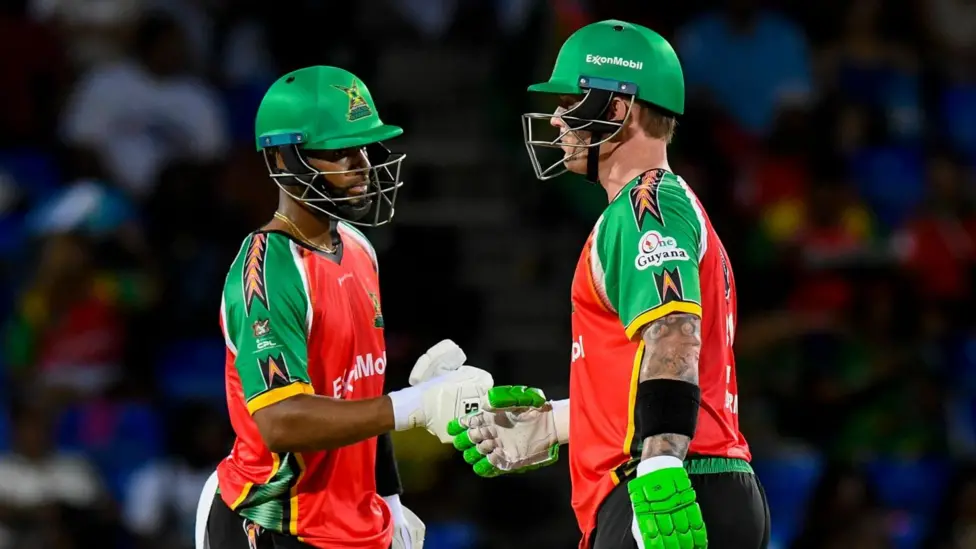
Guyana Amazon Warriors opened their Global Super League 2026 campaign with a three-wicket win over San Francisco Unicorns, sealed under the Duckworth-Lewis-Stern method after rain interrupted the chase at Providence Stadium in Guyana. Chasing a revised target of 131 from 16 overs, the hosts stumbled through a middle-order wobble before Rovman Powell steered them home with three balls to spare. Hammad Azam’s 61 had earlier lifted the Unicorns to 156 for 6. The result, built on Duckworth-Lewis-Stern recalculation rather than a straight run-chase, made match management under changing conditions the defining theme of the contest.
Guyana Amazon Warriors Beat San Francisco Unicorns by 3 Wickets (DLS)
San Francisco Unicorns won the toss at Providence Stadium and chose to bat first. Early inroads from Dwaine Pretorius, who removed Connor Esterhuizen and Sanjay Krishnamurthi inside the powerplay, put the Unicorns under pressure at 13 for 2. Tim Robinson counter-attacked with 38 off 21 balls, and Hammad Azam anchored the innings with a 54-ball 61, adding 45 with Oliver Peake for the fourth wicket. The Unicorns closed on 156 for 6.
In reply, Guyana Amazon Warriors lost Quinton Sampson cheaply before Rahmanullah Gurbaz (31) and Mohammad Haris (30) put on 63 for the second wicket. With the Warriors 66 for 2 in the eighth over, an 80-minute rain delay stopped play and forced a revised target of 131 from 16 overs. A collapse to 93 for 5 followed the restart, but Rovman Powell’s unbeaten 28 — including the winning run off the third ball of the final over — completed the chase with three deliveries in hand.
Match Score Summary
| Team | Runs | Overs | Result |
| San Francisco Unicorns | 156/6 | 20.0 | Batted first |
| Guyana Amazon Warriors | 131/7 | 15.3 (of a revised 16) | Won by 3 wickets (DLS) |
San Francisco Unicorns Innings Analysis
1.Powerplay: The Unicorns lost early ground when Dwaine Pretorius struck twice inside the first three overs, bowling Connor Esterhuizen for a duck and then dismissing Sanjay Krishnamurthi, leaving the total at 13 for 2.
2.Middle overs: Tim Robinson’s rapid 38 off 21 balls, with three sixes and four fours, briefly restored momentum before he fell with the score at 56. Hammad Azam then took charge, combining with Oliver Peake in a 45-run stand for the fourth wicket that carried the innings through its most important phase.
3.Death overs: Guyana’s spinners and seamers tightened the screws late, with Mohammad Nabi trapping Peake lbw to end the key partnership. The Unicorns still found boundaries in the closing overs but could not sustain a final acceleration comparable to Azam’s effort.
4.Key partnerships: The Azam-Peake stand of 45 was the innings’ backbone; without it, the Unicorns’ total would likely have fallen well short of 156.
5.Momentum shifts: Guyana’s early double-strike, Robinson’s counter-punch, and the Azam-Peake rebuild formed three distinct momentum swings inside a single innings.
6.Batting strategy: With early wickets in hand, the Unicorns leaned on Azam’s experience to rebuild rather than continuing an aggressive approach, a trade-off that cost some late-innings acceleration but preserved wickets for a defendable total.
7.Why they finished on 156: Two powerplay wickets, a lack of a second big partnership after the fourth-wicket stand, and disciplined bowling from Pretorius (2/36) and Nabi (2/33) in their four-over spells capped the total below 160.
Guyana Amazon Warriors Chase Analysis
1.Early wickets: Quinton Sampson departed for 4 inside the first over, an early setback similar to the one Guyana’s own bowlers had inflicted on the Unicorns.
2.Gurbaz-Haris partnership: Rahmanullah Gurbaz (31) and Mohammad Haris (30) put together a 63-run stand for the second wicket that put the chase on a stable footing.
3.Rain interruption: At 66 for 2 after eight overs, an 80-minute rain delay halted the match.
4.Revised DLS target: Play resumed with a recalculated target of 131 from 16 overs — a shift in required rate that changed the tactical calculus for the remaining batters.
5.Middle-order collapse: Guyana slipped from a position of control to 93 for 5 as Shimron Hetmyer, Romario Shepherd and Dwaine Pretorius all fell in a short span after the restart.
6.Powell’s finishing role: Rovman Powell held the innings together through the closing overs, finishing unbeaten on 28 and shepherding the tail through the pressure of a reduced-overs chase.
7.Winning over: Six runs were needed off the final over, bowled by left-arm spinner Callum Stow. Matthew Forde opened with a boundary off the first ball, and Powell closed out the match with a single to short mid-wicket on the third delivery.
How the DLS Method Changed the Match
Why the target changed: An 80-minute rain delay meant Guyana’s innings could no longer be completed in the original 20 overs, so the match was reduced to 16 overs per side for the chase.
How DLS works, in simple terms: The Duckworth-Lewis-Stern method recalculates a “fair” target based on the resources a team has left — a combination of overs remaining and wickets in hand — when a match is shortened by weather. It is not a simple run-rate average; it accounts for the fact that a team batting second with wickets in hand can accelerate differently than one already under pressure.
How it affected strategy: Guyana’s revised target of 131 from 16 overs asked for a required rate noticeably higher than the original chase implied. That shift contributed to the aggressive approach that led to the middle-order collapse, before Powell reset the required rate in the closing stages.
Top Performers
| Player | Performance | Impact |
| Hammad Azam (SF Unicorns) | 61 off 54 balls (4 sixes, 2 fours) | Top scorer of the match; anchored the Unicorns past 150 |
| Rovman Powell (GAW) | 28 not out | Unbeaten through the chase; hit the winning run |
| Rahmanullah Gurbaz (GAW) | 31 | Built the platform stand with Haris |
| Mohammad Haris (GAW) | 30 | Partnered Gurbaz in a 63-run second-wicket stand |
| Tim Robinson (SF Unicorns) | 38 off 21 balls (3 sixes, 4 fours) | Fastest scoring rate of the innings |
| Dwaine Pretorius (GAW) | 2/36 | Struck twice in the powerplay to dent the Unicorns’ start |
| Mohammad Nabi (GAW) | 2/33 | Broke the key fourth-wicket stand |
Bowling Analysis
Dwaine Pretorius: Finished with 2 for 36, both wickets coming inside the powerplay when he removed Connor Esterhuizen and Sanjay Krishnamurthi, setting the tone for Guyana’s bowling effort.
Mohammad Nabi: The off-spinner returned 2 for 33 and was the bowler who ended the Azam-Peake partnership by trapping Peake lbw, arresting the Unicorns’ momentum at a key moment.
Ghulam Mudassar: Opened the bowling for the Unicorns and provided the breakthrough in Guyana’s innings, finishing with 2 for 27.
Hassan Khan: Bowled an economical spell, taking 2 for 25 and helping trigger Guyana’s middle-order slide after the rain break.
Death bowling: Callum Stow’s final over, in which six runs were required, ultimately went for the runs needed as Forde and Powell closed out the chase — a reminder of how tight margins were at the death.
Spin vs pace: Both attacks used a mix of pace and spin through the middle overs, with spinners Nabi and Hassan Khan playing outsized roles in the innings’ turning points on a pitch described as spin-friendly.
Batting Analysis
Hammad Azam: His 61 off 54 balls was the innings’ most substantial score and the platform on which the Unicorns’ total was built.
Rahmanullah Gurbaz: Scored 31 and was central to the 63-run stand that gave Guyana’s chase its foundation before the rain delay.
Mohammad Haris: Contributed 30 in the same partnership, complementing Gurbaz through the middle overs.
Rovman Powell: Unbeaten on 28, Powell’s innings spanned the most turbulent phase of the chase and ended with the match-winning single.
Oliver Peake: His 30 alongside Azam in a 45-run stand was pivotal to lifting the Unicorns past 150.
Turning Points of the Match
- Dwaine Pretorius removing Esterhuizen and Krishnamurthi inside three overs to leave the Unicorns 13 for 2
- The 45-run Azam-Peake partnership that rebuilt the Unicorns’ innings
- The 80-minute rain delay at 66 for 2 that reset Guyana’s target to 131 from 16 overs
- Guyana’s collapse from a position of control to 93 for 5 after the restart
- Rovman Powell’s unbeaten stand through the closing overs
- The final over, where Forde’s boundary and Powell’s single sealed the win with three balls to spare
Captaincy & Tactical Decisions
Bowling changes: Guyana’s decision to use Pretorius with the new ball paid off immediately with two powerplay wickets, while introducing Nabi’s spin in the middle overs disrupted the Unicorns’ partnership-building.
Field placements: The match data does not detail specific field settings; any claims beyond bowler changes and wicket outcomes would be speculative and are not included here.
Rain management: Both sides had to adjust to the 80-minute stoppage and the recalculated 16-over target — a scenario that rewards teams able to reassess required run rates quickly, which Guyana ultimately did despite the mid-innings wobble.
Batting order decisions: San Francisco’s choice to bat first after winning the toss, and Guyana’s top order approach before and after the rain break, shaped both innings; no further batting-order changes are recorded in the available data.
Key Match Statistics
| Statistic | Detail |
| Highest scorer | Hammad Azam — 61 (54 balls) |
| Best bowling figures | Pretorius 2/36 and Nabi 2/33 (joint-best) |
| Best partnership | Rahmanullah Gurbaz & Mohammad Haris — 63 (2nd wicket) |
| Unicorns powerplay score | 13/2 |
| Winning margin | 3 wickets |
| Balls remaining | 3 balls (won in 15.3 of 16 overs) |
| Revised target | 131 from 16 overs (DLS) |
| Rain delay duration | 80 minutes |
Weather & Pitch Report
Conditions at Providence Stadium featured light rain, 24°C temperatures and 92% humidity, with wind speeds around 2.86 mph and 33% cloud cover. The pitch was described as a spinning surface with average batting conditions, swing-favourable for pace bowlers and conducive to slow spin. These conditions help explain both Pretorius’s early powerplay success with the new ball and the influence of spinners Nabi and Hassan Khan through the middle overs, as well as the rain interruption that ultimately triggered the DLS recalculation.
What This Win Means for Guyana Amazon Warriors
The win gives the defending champions a positive start to their Global Super League 2026 campaign, coming through a rain-affected, DLS-defined chase rather than a straightforward run pursuit. Overcoming a middle-order collapse after the rain break to close out the match reflects well on the depth of the batting order, particularly Rovman Powell’s finishing. Broader tournament standings and net-run-rate implications were not part of the available match data and are not addressed here.
What San Francisco Unicorns Need to Improve
Top-order stability: Losing two wickets inside the first three overs put the innings on the back foot before Robinson and Azam could respond.
Middle-order acceleration: Beyond the Azam-Peake stand, the innings did not generate a second significant scoring burst, which likely capped the total below what the conditions may have allowed.
Death bowling: Callum Stow’s final over went for the six runs required, underlining a need for tighter execution at the death in future fixtures.
Fielding: No specific fielding lapses are recorded in the available match data.
Playing XIs
Note: The following reflects only the players referenced in the verified match data (batters, bowlers and fielders mentioned in dismissals, partnerships and bowling figures). Full XIs were not published in the source material.
San Francisco Unicorns (players referenced):
| Player | Role in Match |
| Connor Esterhuizen | Opener, dismissed for 0 |
| Sanjay Krishnamurthi | Top order, dismissed early |
| Tim Robinson | 38 off 21 balls |
| Hammad Azam | 61 off 54 balls, top scorer |
| Oliver Peake | 30, part of 45-run stand |
| Fabian Allen | Involved in later order (fall of wicket recorded) |
| Ghulam Mudassar | Bowler, 2/27 |
| Hassan Khan | Bowler, 2/25 |
| Callum Stow | Bowler, bowled the final over |
Guyana Amazon Warriors (players referenced):
| Player | Role in Match |
| Quinton Sampson | Opener, dismissed for 4 |
| Rahmanullah Gurbaz | 31, 63-run 2nd wicket stand |
| Mohammad Haris | 30, 63-run 2nd wicket stand |
| Shimron Hetmyer | Dismissed during middle-order collapse |
| Romario Shepherd | Dismissed during middle-order collapse |
| Dwaine Pretorius | Bowler (2/36) and batter, dismissed during collapse |
| Mohammad Nabi | Bowler (2/33), dismissed at 107 |
| Rovman Powell | 28 not out, finished the match |
| Matthew Forde | Struck the boundary in the final over |
Expert Match Analysis
Guyana Amazon Warriors’ win was decided as much by their bowlers’ powerplay discipline as by their batters’ finishing under pressure. Pretorius’s two early wickets against the Unicorns mirrored the pressure Guyana’s own top order faced after Sampson’s dismissal, and both innings ultimately hinged on a single substantial partnership — Azam-Peake for the Unicorns, Gurbaz-Haris for Guyana. The rain delay and subsequent DLS recalculation added a layer of complexity that Guyana navigated imperfectly, losing three wickets in quick succession after the restart, but Powell’s composed unbeaten innings was decisive in closing out a target that had shifted mid-match. This analysis is based solely on the verified sequence of events, partnerships and figures from the match.
Key Takeaways
- Guyana Amazon Warriors won by 3 wickets under the DLS method, chasing a revised target of 131 from 16 overs
- Hammad Azam’s 61 was the highest individual score of the match
- Rovman Powell’s unbeaten 28 sealed the win in the final over
- An 80-minute rain delay reset Guyana’s target and required rate
- Dwaine Pretorius and Mohammad Nabi were Guyana’s most successful bowlers, with 2 wickets apiece
- The match was played at Providence Stadium, Guyana, under spin-friendly pitch conditions